Jerguson Weld Pads |
|||||
Jerguson Welding Pad Gages are used where conventional gage and valve construction is impractical because of (1) solid matter in suspension, (2) under conditions where the thermal error caused by piping to a gage glass cannot be tolerated, or (3) where space requirements suggest their use. Included are applications involving high vibration, highly viscous liquids or liquids with considerable amounts of solids, Jerguson offers end users a flat or radius weld pad gage. Because there is no nipples through which the process liquid enters the gage, clogging potential is eliminated. Jerguson Welding Pad Gages are made in both Reflex and Transparent types ... in most Jerguson standard sizes. Reflex gages are used where liquid level reading only is required. Transparent gages are usually used where installation is made on each side of the vessel to give see-through visibility. |
|||||
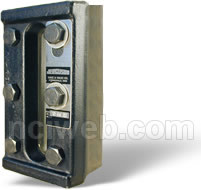 Standard
Welding Pad Gages Standard
Welding Pad Gages
Design and Installation: Standard Jerguson welding pad gages follow other Jerguson flat glass gages in general design and materials, except for the method of attaching to the tank or vessel. The chamber of the welding pad gage consists of a bar stock pad, which is welded to the tank after cutting a slot in the tank wall equal in dimension to the vision slot of the gage. Alternately, for maximum vessel strength without further reinforcement, two holes may be drilled in the tank wall with diameters equal to the width of the vision slot of the gage located at the top and the bottom of the visible range. For best results the tank wall behind a reflex gauge should provide a dark background. The holes, in lieu of of the slot method, can be used with a transparent type when there's sufficient visual contrast between the tank wall in the liquid to permit liquid level interface observation. Pressure loads:Where it is necessary to slot the tank because of the nature of the liquid or there is need to observe the color or interface of the liquid, the following facts must be considered: Standard and welding pad gages will withstand a loading due to the pressure within the gage itself, but they are not designed to replace the tank strength lost with tank wall is cut. The gage manufacturer has no control over the loading in which the pressure vessel will impose on the pad. It is therefore impossible to rate welding pad gages. The tank fabricator must provide suitable tank wall reinforcement to prevent the pad from being distorted during welding or while under hot operating condition. 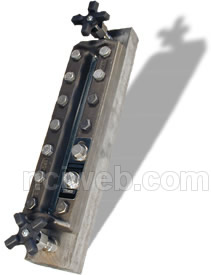 Materials
and construction: Materials
and construction:
Jerguson welding pad gages are engineered and build to Jerguson's high standards, using materials found by test to be the best for the particular application. The welding pad than in may be made of any material desired to withstand corrosive or other conditions. To prevent distortion and during welding, welding pad gages may be furnished with a cold rolled steel space or to replace glass and gaskets. Isolable Welding Pad GagesJerguson Isolable Welding Pad gages with control valves follow the general design of standard Jerguson welding pad gages but offer the additional advantages of integral valves. Because the gauge can be isolated from the vessel by the valves, gaskets or glass can be replaced without lowering the level of liquid below the gage inlet or relieving pressure from the vessel. Isolable gages are installed by matching valve inlets with holes drilled in the vessel in making a 100 percent for fillet Weld between the vessel wall and valve inlets. The gauge chamber is tack welded to the vessel. |
|||||
| Previous Page |

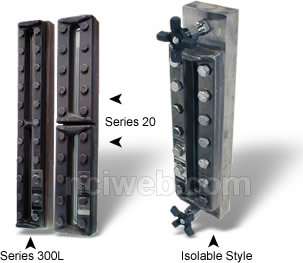 Flat
glass liquid level gages designed to become an integral part
of the vessel.
Flat
glass liquid level gages designed to become an integral part
of the vessel.