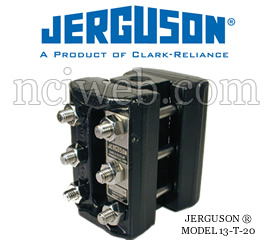
Jerguson ® Level Gages
 One of the simplest techniques for indicating liquid level
is by means of a direct reading device with which the level
can be seen visually. A common method of providing such visual
indication is by installing direct reading gages in the vessel
itself. These direct reading gages are placed at different
locations or points to indicate the liquid height. More often,
separately mounted gage glasses are used to provide a continuous
indication of level over a certain vertical distance on the
vessel. One of the simplest techniques for indicating liquid level
is by means of a direct reading device with which the level
can be seen visually. A common method of providing such visual
indication is by installing direct reading gages in the vessel
itself. These direct reading gages are placed at different
locations or points to indicate the liquid height. More often,
separately mounted gage glasses are used to provide a continuous
indication of level over a certain vertical distance on the
vessel.
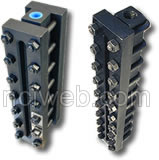
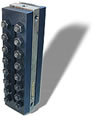
The transparent
glass gage consists of a one piece central chamber
with cover plates oneach side that hold the two glass
windows. The chamber and cover plates have machined
recesses that keep all the parts aligned and prevent
the gaskets and cushions from shifting. When the level
of caustic or acidic fluids is indicated, the inside
surfaces of both glasses are lined with a protective
coating of transparent mica. After prolonged exposure
to high temperature, chemically-treated water, the
mica will become opaque. This discoloration indicates
that the mica has failed and water is now in direct
contact with the glass. When this happens, the glass
should be changed, before it fails. See
Glass Example
The
glass itself is also tempered for resistance to both
mechanical and thermal shock. Care must be taken when
assembling the unit and tightening the bolts to prevent
glass failure. It is safest to use the crossover method
of tightening by starting at the center and working outwards.
Besides being suitable for caustic
and acidic liquids, the flat glass is also suitable for
dirty materials, high pressure steam applications and
other service where it is necessary to illuminate the
glass from the rear.
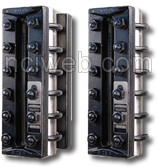
The reflex
gage is best suited for clean, colorless, non-viscous,
and non-corrosive fluids including light and heavy
hydrocarbons. This gage has special optical properties
that create a sharp line of demarcation at the liquid
level. A dark area represents the liquid in the glass
gage contrasted by a light area above the liquid. Our Gage & Valve
Selector Slide Rule is shown to the right (can't
get that from the competition !) |