
Northeast Controls Inc. · Eductors – Jet Pumps
Liquid Eductors & Jet Pumps
No moving parts · Self-priming · Handles solids, corrosives & high temperatures
Water jet eductors — also known as jet pumps — utilize the kinetic energy of one liquid to cause the flow of another. They operate on the basic principles of flow dynamics: a high-pressure motive stream is accelerated through a tapered nozzle, increasing its velocity and creating a low-pressure zone that draws in the suction fluid. The two fluids mix in the throat and are discharged together through a diverging diffuser that recovers pressure.
Because there are no moving parts, eductors require virtually no maintenance and can handle fluids that would rapidly destroy mechanical pumps — including slurries, corrosives, liquids with entrained gas, and high-temperature process streams. They are inherently self-priming and safe for hazardous areas.
Eductor / Jet Pump Finder
Find the right eductor type for your application.
What is your application?
Eductor Model Series
Five standard series cover liquid and steam/gas motive applications across a wide range of pressures and flow rates. All models are full ANSI rated and manufactured to ISO 9001 standards.
Inline Eductors
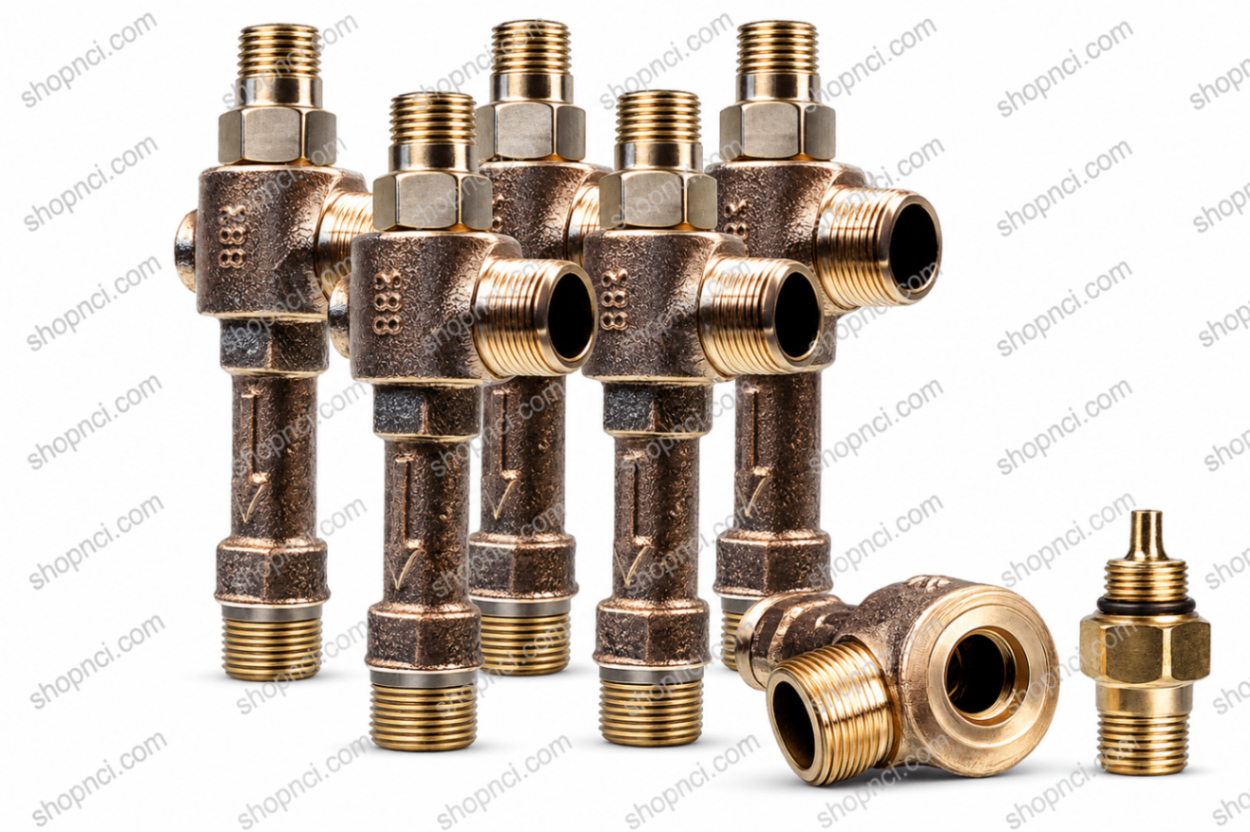
½" – 3" in Carbon Steel, Bronze & 316 Stainless Steel
Standard sizes available for immediate shipment. No lead time on stocked configurations.
Tank Eductors
⅜" – 3" in Carbon Steel & 316 Stainless Steel
3" 316SS also available with 150# ANSI flanged connections from stock.
Performance
Description
General-purpose liquid jet pump for water, light oils, and compatible process fluids. Ideal for low-to-medium pressure applications where simplicity and reliability are paramount.
Typical Applications
- →Sump drainage
- →Chemical transfer
- →Cooling water recirculation
- →Low-pressure liquid pumping
Performance
Description
Higher pressure recovery than the SL series. Suited for applications requiring moderate discharge pressure or longer discharge runs.
Typical Applications
- →Boiler feed assistance
- →Process liquid transfer
- →Condensate return
- →Moderate-head pumping
Performance
Description
Maximum pressure recovery in the liquid series. Designed for high-discharge-pressure requirements where maximum energy transfer from motive to suction fluid is needed.
Typical Applications
- →High-head liquid transfer
- →Pressurized vessel filling
- →Elevated discharge applications
- →High-pressure process systems
Performance
Description
Steam-powered eductor for gas compression, vacuum generation, and gas-liquid mixing. Converging-diverging nozzle allows motive steam to reach sonic velocity.
Typical Applications
- →Vacuum generation
- →Gas compression
- →Steam-jet refrigeration
- →Odor control
Performance
Description
Enhanced pressure recovery steam eductor for demanding gas compression and vacuum applications. Higher entrainment ratio than the SG series.
Typical Applications
- →Multi-stage vacuum systems
- →High-volume gas exhausting
- →Thermocompressor service
- →Steam-jet ejector systems
How an Eductor Works
All venturi eductors share three connections. Understanding each connection is key to proper sizing and installation.
Motive Connection
Where the power for the eductor is generated by increasing the velocity of the motive fluid through a tapered nozzle. The motive fluid enters at high pressure and exits the nozzle at high velocity, creating a low-pressure zone in the suction chamber.
Suction Connection
Where the pumping action takes place. The high-velocity motive jet creates a low-pressure zone that draws in the suction fluid. The two fluids mix in the suction chamber and throat section.
Discharge Connection
The combined fluids pass through a diverging diffuser that converts kinetic energy back to pressure. The discharge pressure is always between the motive pressure and the suction pressure.
Key Operating Principle
The discharge pressure of an eductor is always between the motive pressure and the suction pressure. The eductor cannot discharge against a pressure higher than the motive pressure. For liquid motives, the ratio of suction flow to motive flow (entrainment ratio) typically ranges from 0.3:1 to 1.5:1 depending on the model and operating pressures. Providing a smooth flow path is critical to optimum performance — ultra-smooth machining of the nozzle and mixing tube ensures maximum energy transfer and superior performance compared to competitive units.
In-Line Eductor Performance Table
| Description | Model SL | Model ML | Model HL | Model SG | Model HG |
|---|---|---|---|---|---|
| Motive Media | Liquid | Liquid | Liquid | Steam | Steam |
| Motive Pressure (PSIG) | 15–250 | 15–250 | 15–250 | 30–150 | 20–150 |
| Pressure Recovery % | 10–15 | 30–35 | 40–50 | 15–20 | 30–35 |
| Maximum Suction Lift | -27 ft. | -27 ft. | -27 ft. | -20 ft. | -20 ft. |
Sizing Reference — Liquid Eductors
Approximate flow ranges for standard liquid eductor sizes at typical operating pressures. Actual performance depends on motive pressure, suction conditions, and discharge pressure. Contact Northeast Controls for a detailed sizing calculation.
| Pipe Size | Motive Flow (GPM) | Suction Flow (GPM) | Discharge Pressure (PSIG) |
|---|---|---|---|
| ¼" | 0.3–1.2 | 0.1–0.5 | 5–40 |
| ⅜" | 0.6–2.5 | 0.2–1.0 | 5–40 |
| ½" | 1.0–4.5 | 0.4–2.0 | 5–60 |
| ¾" | 2.0–9.0 | 0.8–4.0 | 5–80 |
| 1" | 3.5–16 | 1.5–7.0 | 5–100 |
| 1½" | 8–36 | 3–15 | 5–150 |
| 2" | 14–65 | 5–28 | 5–200 |
| 3" | 32–145 | 12–60 | 5–250 |
| 4" | 55–250 | 20–100 | 5–250 |
| 6" | 125–560 | 45–220 | 5–250 |
Flow ranges are approximate and vary by model series and operating conditions. Sizes from ¼" through 12" and larger available. Custom sizes and configurations on request.
Materials of Construction
Eductors are available in a wide range of materials to match your process fluid, temperature, and pressure requirements. All metallic units are full ANSI rated and meet ASME/ANSI B16.5.
Bronze
IN STOCKStandard for water, steam, and general service. Most economical.
Cast Iron— No Longer Offered
For larger sizes and non-corrosive services.
Carbon Steel
IN STOCKFor higher pressures and temperatures.
316 Stainless Steel
IN STOCKFor corrosive liquids, acids, caustics, and food-grade applications.
304 Stainless Steel
General corrosion resistance; lower cost than 316 SS.
Alloy 20
For sulfuric acid and highly corrosive chemical service.
Hastelloy C
For extremely aggressive chemical environments.
PVC / CPVC
For corrosive chemical tanks; plastic tank eductor service.
Polypropylene
For aggressive acids and alkalis in plastic tank applications.
Titanium
For seawater, chlorine, and highly oxidizing environments.
PVDF (Kynar®)
For halogenated solvents and ultra-pure applications.
Monel
For hydrofluoric acid and marine service.
Why Choose an Eductor?
Eductors outperform mechanical pumps in many applications — especially where reliability, chemical compatibility, or hazardous area safety are critical.
No Moving Parts
Zero mechanical components means no wear, no seals to replace, and no lubrication required. Maintenance is essentially zero.
Self-Priming
Eductors prime themselves automatically — no priming pump, foot valve, or operator intervention needed.
Handles Difficult Fluids
Pumps slurries, viscous liquids, liquids with entrained gas, corrosives, and high-temperature fluids that would damage mechanical pumps.
Explosion-Proof by Design
No electrical components at the pump location. Inherently safe for hazardous areas — no ATEX or NEC classification required for the eductor itself.
Compact & Lightweight
Installs inline with standard pipe fittings. No baseplate, coupling, motor, or pump casing required.
Wide Material Range
Available in bronze, cast iron, carbon steel, stainless steel, Hastelloy, PVC, CPVC, polypropylene, titanium, and other alloys.
Low Capital Cost
Significantly lower installed cost than centrifugal or positive displacement pumps for many transfer and mixing applications.
Quiet Operation
No mechanical noise from rotating parts. Operates quietly with only the sound of flowing fluid.
Common Applications
Eductors serve a broad range of industries including chemical processing, petrochemical, pharmaceutical, food & beverage, power generation, water treatment, and marine.
Chemical Transfer
Transfer corrosive acids, caustics, solvents, and slurries without mechanical seals or impellers that can fail or contaminate the process.
Sump & Pit Drainage
Drain sumps, pits, and low-lying areas using plant water or process fluid as the motive. No electrical connections required at the sump.
Solids Handling
Pump slurries, sludges, and liquids containing suspended solids up to 50% by weight. No impeller to clog or wear.
Vacuum Generation
Create vacuum for distillation, filtration, drying, and degassing using steam or compressed gas as the motive fluid.
Priming Centrifugal Pumps
Self-prime centrifugal pumps by evacuating the suction line. Eductors are inherently self-priming and require no priming themselves.
Sampling & Metering
Accurately sample process streams or meter small flows of reagents into a process line using the venturi effect.
Gas Scrubbing
Absorb and neutralize toxic or odorous gases by contacting them with a scrubbing liquid in the eductor throat.
Heating & Sparging
Inject steam directly into a liquid stream for heating, or sparge gas into a liquid for aeration or reaction.
Construction & Quality Features
In-Tank Eductor Styles
Beyond inline jet pumps, eductors are widely used inside tanks for mixing, heating, and agitation — with no moving parts, no seals, and no maintenance. Motive fluid enters from outside the tank and drives circulation or heat transfer entirely within the vessel.
Mounted inside the tank, these eductors use a motive liquid to induce high-volume circulation and thorough mixing without mechanical agitators. Ideal for blending, suspension, and homogenization.
Learn more →Tank Heating EductorsSteam or hot liquid motive fluid heats tank contents by direct injection and circulation. Eliminates external heat exchangers and provides rapid, uniform temperature rise.
Learn more →Plastic Tank EductorsPVC, CPVC, and polypropylene construction for corrosive chemical tanks. Same no-moving-parts design in materials suited for acids, caustics, and aggressive process fluids.
Learn more →Steam Heaters / InlineDirect steam injection heaters for inline or tank applications. Steam is the motive fluid — condensate mixes with the process liquid, delivering efficient heat transfer with no heat exchanger fouling.
Learn more →Sizing an Eductor — What We Need
To size an eductor accurately, provide the following information on the Jet Pump Application Sheet:
Related Products
Contact Our Eductor Sales Team
1+201-419-6111 · [email protected]
Quick RFQ
Request Pricing